
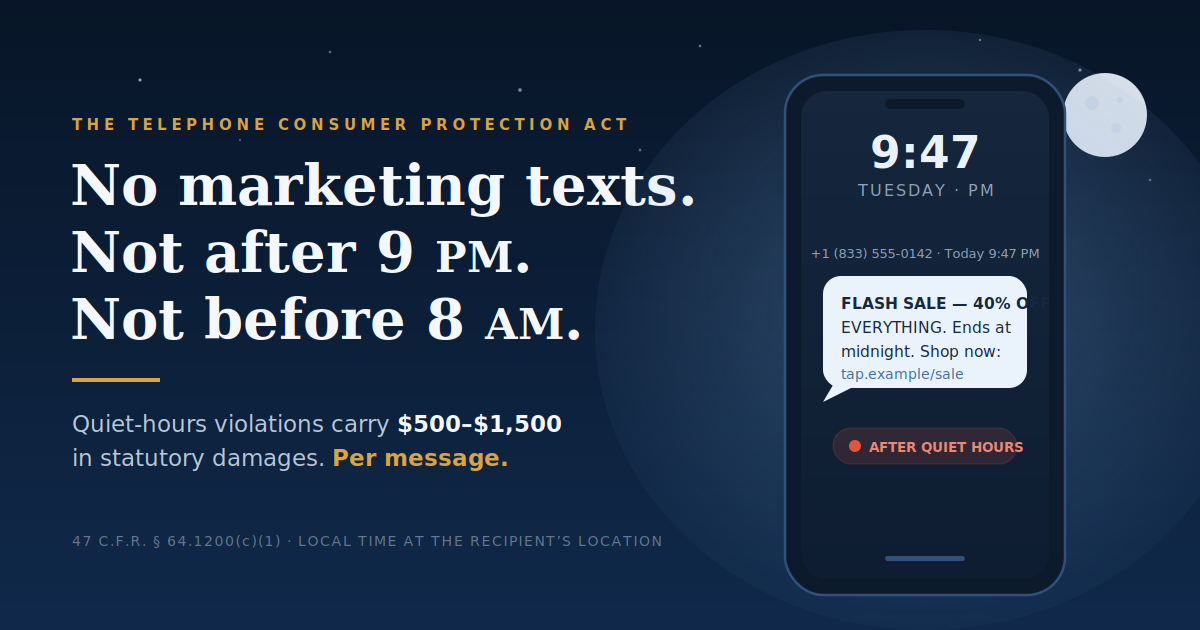
It's 9:47 on a Tuesday night. Your phone lights up: "FLASH SALE — 40% OFF." You didn't ask for it. You delete it. That was a mistake.
The Telephone Consumer Protection Act restricts when telemarketers can contact you. Marketing texts sent before 8 AM or after 9 PM your local time can violate the law — and the TCPA gives you the right to sue for $500–$1,500 per message.
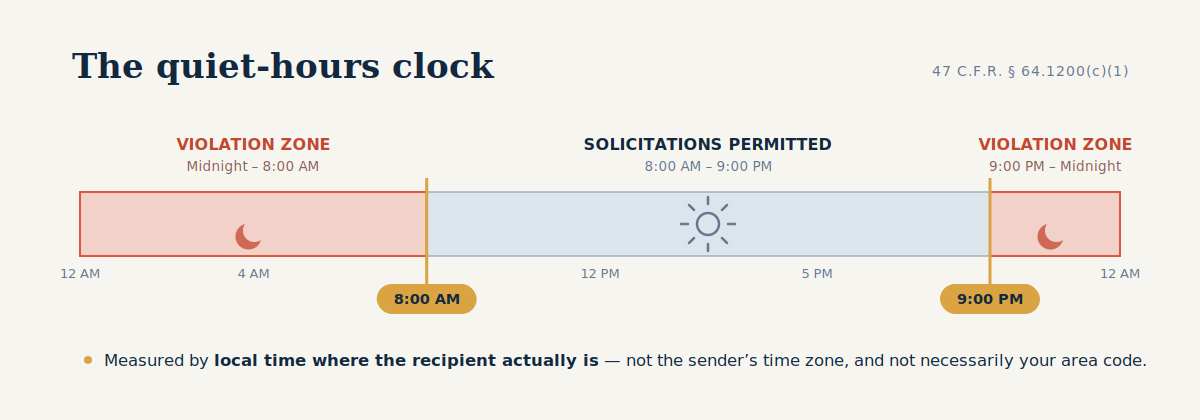
Three Things Most People Don't Know
Texts count the same as calls in many jurisdictions.
In many jurisdictions, a 9:30 PM promotional text is analyzed the same way as a 9:30 PM telemarketing call under the TCPA.
"Local time" means YOUR time — where you actually are.
Not the sender's time zone. Not your area code. The clock at your physical location when the message arrived.
Your personal cell phone counts.
Many courts routinely treat personal wireless numbers as residential lines for quiet-hours purposes.
Not sure if your texts qualify?
Answer a few questions. Our AI analyzer checks your facts against the TCPA in about 2 minutes.
Check My Messages FreeFree. No obligation. No credit card.
What Counts as a Violation
For a message to violate the quiet hours rule, four elements must line up:
The message encouraged you to buy, rent, or invest in something.
Before 8 AM or after 9 PM, your local time, at your actual location.
It went to your residential or personal cell number.
More than one violating text/call from the same company within 12 months.
The consent question matters.
If you signed up for a company's texts, courts may find quiet hours don't apply. Your claim is strongest if you never gave the company your number, or if you opted out (texted STOP) and the messages continued.
What Your Texts Could Be Worth
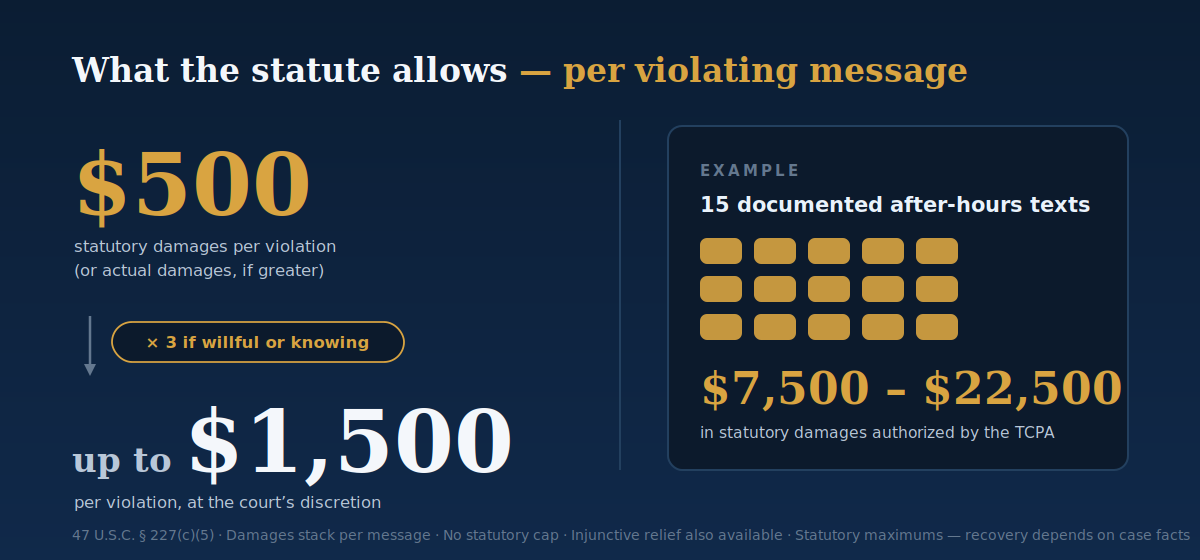
| Messages | At $500 each | If willful ($1,500) |
|---|---|---|
| 5 | $2,500 | $7,500 |
| 15 | $7,500 | $22,500 |
| 40 | $20,000 | $60,000 |
These figures show what the statute authorizes, not a promise of recovery. Prior results do not guarantee a similar outcome. Each case is different. 47 U.S.C. § 227(c)(5).
How many after-hours texts are on your phone right now?
Every message you delete is evidence gone. Every month you wait, carrier records expire.
Run My Evidence Through the AnalyzerHow to Build Your Evidence File
TCPA cases are won on records. Start tonight — it takes 10 minutes:
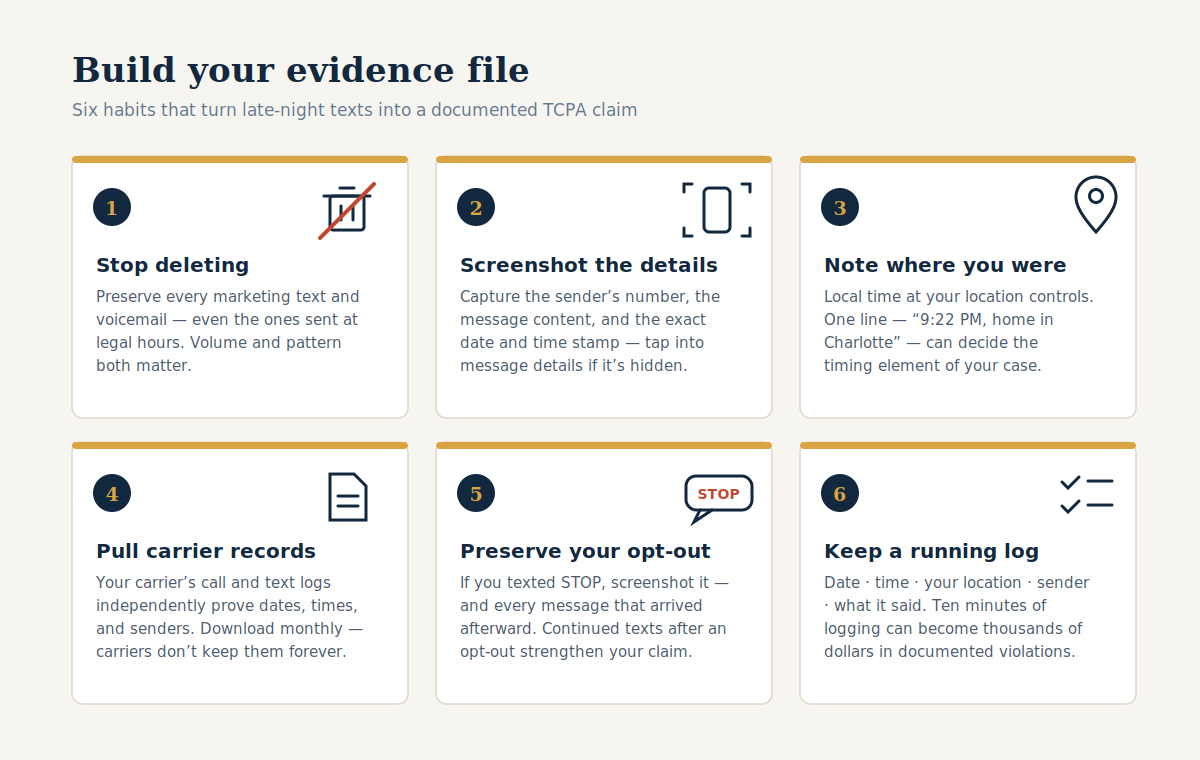
Stop deleting
Preserve every marketing text — volume and pattern matter.
Screenshot everything
Sender number, content, and exact date/time stamp.
Note your location
"9:22 PM, home in Charlotte" decides the timing element.
Pull carrier records
Download monthly — carriers don't keep them forever.
Save your STOP reply
Screenshot it and everything that arrived after.
Keep a running log
Date, time, location, sender, content. 10 min = thousands in documented violations.
Common Questions
Does a single late-night text violate the TCPA?
It may violate the rule, but to sue for damages you generally need more than one violating text from the same company within 12 months. That's why preserving every message matters.
I signed up for the store's texts. Do quiet hours still protect me?
This is currently contested. At least one court has held that consenting means quiet hours don't apply (King v. Bon Charge, 2026). Your claim is far stronger if you never consented — or if you opted out and the texts continued.
What if I was traveling when the message arrived?
The rule uses local time at your location when the message was received. A text at 8:58 PM where the sender sat may have been 9:58 PM where you were — that's a violation.
Do I need to be on the Do Not Call Registry?
No — quiet hours apply regardless. But if your number is on the Registry and you're still getting solicitations, you may have additional claims.
How much does it cost to pursue a TCPA claim?
Our firm handles TCPA claims on a contingency basis: you pay nothing unless we recover for you. You may be responsible for case costs and expenses — we'll explain how costs are handled in your matter.
How long do I have?
TCPA claims generally must be brought within four years, but evidence disappears much sooner — phones get replaced, carrier records expire, companies purge logs.
Those Late-Night Texts Are Still on Your Phone.
Find out in 2 minutes whether they're a nuisance — or a case worth thousands.
Attorney Advertising. This article is for general informational purposes only and does not constitute legal advice. Reading it or using the TCPA Case Analyzer does not create an attorney-client relationship. TCPA law is evolving — court decisions and FCC rulings may affect the claims described here — and every case depends on its specific facts. Deadlines apply. If you believe your rights were violated, consult a qualified attorney promptly. Our firm handles TCPA claims on a contingency basis: you pay nothing unless we recover for you. You may be responsible for case costs and expenses. We will explain how costs are handled in your matter.